This award will be announced when funding is available.
2012 Award
The 2012 ECTS/Servier Fellowship was presented to Corinne Collet (Paris, France) during the ECTS 2012 congress in Stockholm, Sweden). Many thanks are extended to Servier for supporting this award.
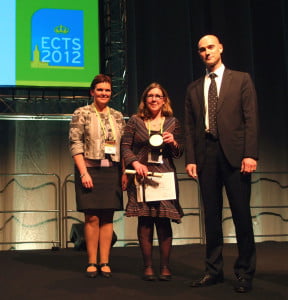
Corinne Collet (Paris, France) with ECTS President, Bente Langdahl and Philippe Halbout (Servier)
Project
Serotoninergic system and the control of bone formation
Our proposal is to determine the interrelation between two important biological and medical problems: the serotoninergic system and steoporosis. Serotonin system is described on bone however its function is unclear. We intended to evaluate the action of serotonin system in bone formation both in vivo and in vitro using several genetic animal models and with the help of pharmacological tools. Our aim is to lead to the discovery of therapeutic agents, acting as agonists or antagonists of the various different molecules in the serotoninergic system on bone.
2010 Award
Saba Adbulghani (Lisbon, Portugal)
Structural and mechanical evaluation of the mineral and organic phases in osteoporotic bone using an animal model of osteoporosis
Osteoporosis OP is as a systemic bone disease, characterised by low bone mass and microarchitectural deterioration of the bone tissue, leading to enhanced bone fragility and increased fracture risk. OP is believed to be linked to an imbalance in the remodeling process where more bone is being removed than is being rebuilt through cellular activities. Such imbalance is believed to induce changes in the bone’s components mineral and organic phases, which are responsible for its strength and stiffness, and consequently lead to degraded mechanical properties. Therefore the aim of this study is to characterise the bone’s mineral and organic phases during different stages of OP in a mouse model and show that such changes are responsible for the degraded mechanical properties of the osteoporotic bone which consequently lead to its higher fragility and increased fracture risk.
2009 Award
Nicolas Vilayphiou (Lyon, France)
Osteoporosis is a skeletal disease affecting mostly postmenopausal women and decreasing the resistance to fracture of bones. Low bone mineral density has been determined as an indicator of risk for fragility fractures. However, about half of those fractures occur in postmenopausal women who not have osteoporosis defined on BMD criteria. So we need other techniques to improve the prediction of fracture. Bone mineral density is a surrogate for bone mass, but this does not directly predict its strength as mechanical parameters would do. Moreover, other parameters of bone quality must be taken into account, e.g. the bone microarchitecture. We propose to investigate jointly bone mineral density, bone microarchitecture and mechanical aspects with finite element analysis, and their relation to fragility fractures in a cohort of 890 women, aged from 26 to 92 years old.